This article is more of a sharing experience type. For a musician who doesn’t have a music store where he can put his hands and ears on many instruments to choose and compare, it is hard to decide only over an opinion on a forum or even after hearing / seeing a video on YouTube or other video sharing sites. Talking about video and hearing a guitar in the hands of another player is the most tricky part. After many years of fooling around with gears of all kinds and hearing many good players, I came to the final conclusion: the tone is in your hands. By hands I mean you, as a summation of the music that you listen to, concerts that you’ve seen, books that you’ve read etc, and all the psychological and physical factors that you’re made of.
For example, if BB King had played on a Rickenbacker guitar instead of his Gibson Lucille, it would have sounded the same as BB King, and that’s for sure. Of course you could say that wouldn’t be the same on a pedal guitar for metal music (what with the very high gain). I’m sure that he would lower the volume and tone on the guitar or refused to play. I recommend you to see this workshop of Greg Kock’s beginning with 9:50
; it wouldn’t hurt if you had a look at the entire video. This is what I’m talking about. In conclusion, I must say that there’s no one in the world who could tell you how a gear in your hands might sound. Even if you see a demo that sounds really good, it’s not a guarantee that it will sound good in your hands, and that’s for two reasons. The main reason is your hands are not the same as the ones of the person doing the demo. The second reason is the gear combination. Stepping over the “hands” problem, in my opinion there is no bad-sounding gear; instead, there are bad-sounding combinations of gears. For example: I have an 65 Fender Deluxe Reverb RI which is very demanding in regards to the pedals that I use. At the beginning, I thought the pedals were bad. Only a few pedals were sounding really good to me. Then, I tried all the pedals on another amplifier. Other pedals sounded good, and so on.
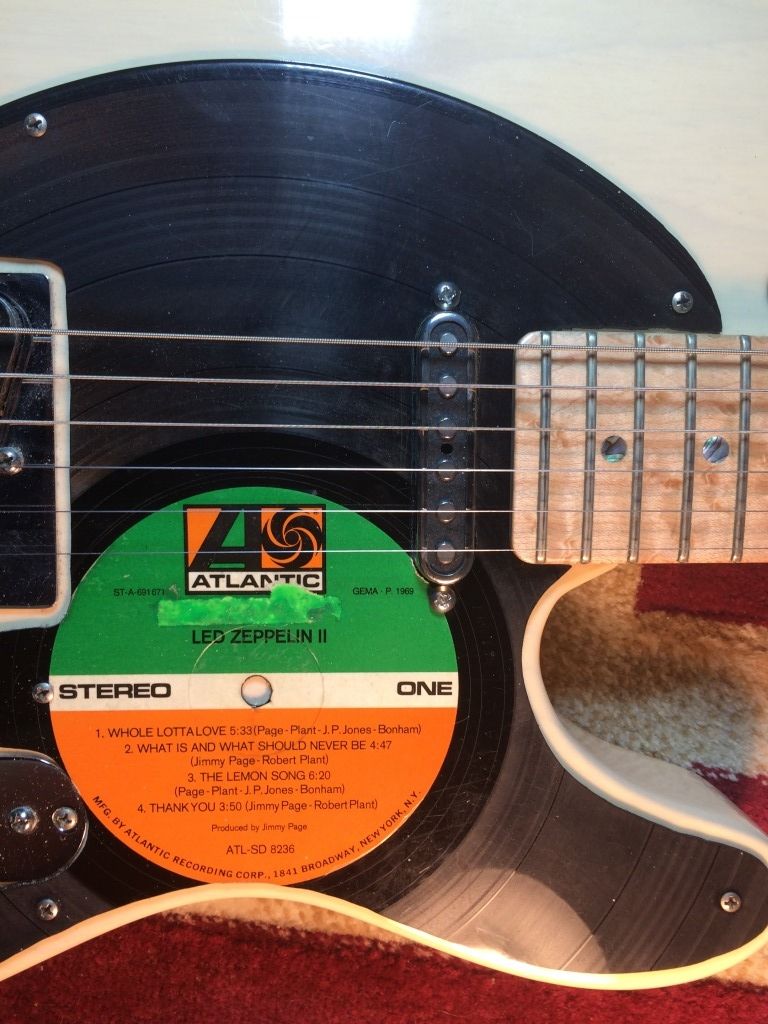
Now to start on the main subject. What I’m about to say is only to give you a clue and not to convince you. I have a 2011 Fender Custom Shop Deluxe Telecaster. The main reason I bought this guitar was for the Twisted Tele pickup in the neck position and for the Ash Body lightweight hand selected. I only decided for this guitar after I had the opportunity to put my hands on a Fender custom shop unit with the same wood and pickup. At that moment, I realized it was the guitar that I was searching for.
After some years of usage on stages with a very good care, my Twisted Tele pickup started to have some connection problems (that I thought were due to a bad patch cable), and one day, the pickup didn’t want to work at all. I removed the pickup and I discovered that the problem was inside the bobbin. Well, I needed to buy another one. I was really pissed off when I found out that there are two types of Fender Twisted Tele pickups for this type of neck position: one with a green wire, used on the Baja Telecaster made in Mexico, and another with a white wire used in the Custom Shop. On ebay some guys are selling the mexican version as being the original one for Custom Shop. Very annoying. I’m sure that the difference between those two is more psychological but I’m a human being and OCD is a nice style of living.
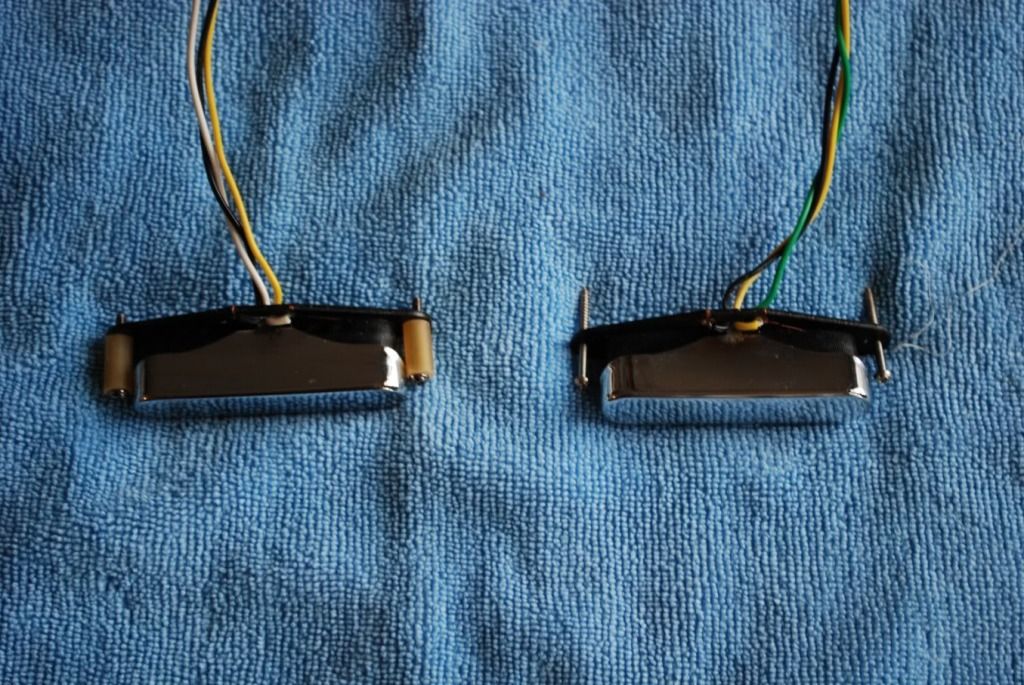 | |||
| Fender Twisted Tele pickups left - Custom Shop right - Baja |
On the other hand, I thought it was an opportunity to try something new and maybe better. With no possibility to try other pickups from the same sound range as the Twisted Tele, I started to search on forums and YouTube. The Fender Twisted Tele is well-known for sounding like a stratocaster pickup for telecasters, and this is what I was searching for. Why didn’t I decide for a stratocaster in the first place? Well, I don’t like the middle pickup (I hit the strings hard and this pickup was standing in my way), I don’t like the springs in the back of the guitar (when I bend a string the others slightly drop down), and I’m definitely a telecaster guy. After a few searches, I discovered the Lollar Royal T pickup. I found some guitarist on the internet comparing the latter to the Twisted Tele along the Dimarzio twang king.
After reading the description of the Lollar Royal T pickup “We love Teles. But every once in a while even the most die-hard Tele-philes want to channel their inner Jimi. Don’t feel bad. We don’t blame you. We are here to help. You don’t need to carve up your pickguard. You don’t need to hack up your guitar. You just need some “Royal T”… ”, and seeing the following video
, as well as reading on a forum that someone was saying that this pickup sounded more like a stratocaster than a Twisted Tele (holy Stephen Hawking, more strat!!!... shut up and take my money), I bought this pickup.
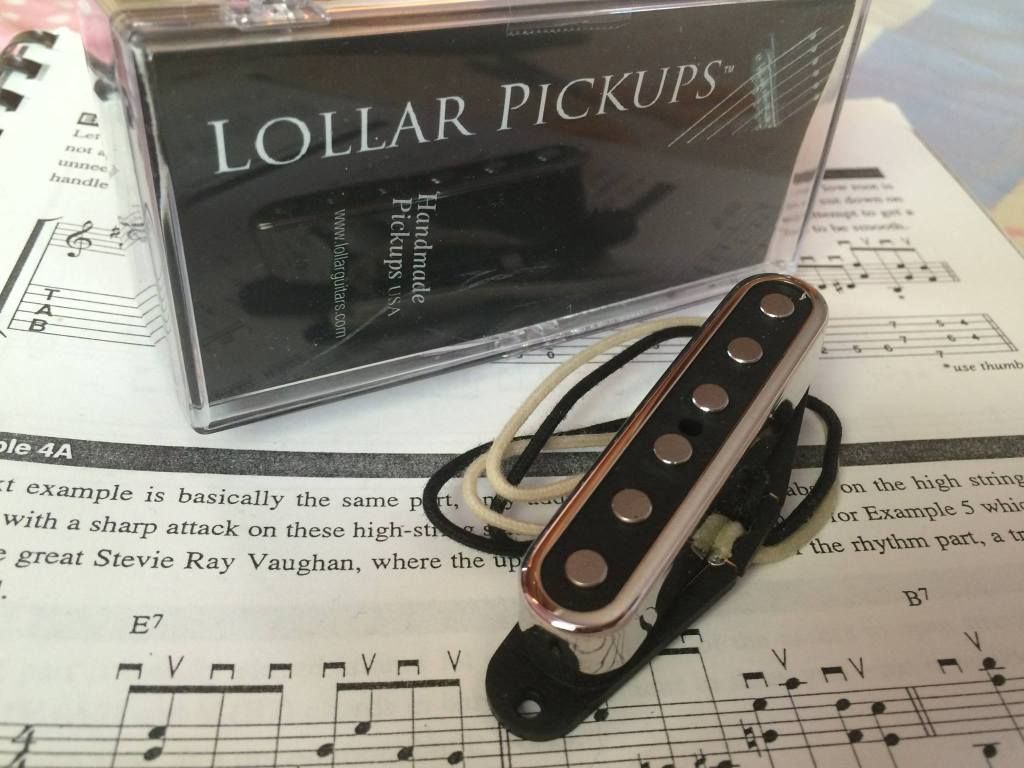 |
| Lollar Royal T pickup |
My first impression was that the pickup looked awesome and very well-built. Easy to install, it took just a couple of minutes. Immediately I plugged it in (at home) to hear it. At the beginning I was kind of disappointed. At that moment, the sound was not the same or better than the Twisted Tele. It was different. Not completely different. Just a little different. But that twang was there, for sure. The bass frequencies were not the same and there were some strong mids. At my home, the twisted tele sounded very warm and pleasant with the very beautiful low end that Lollar didn’t have. On the other hand, the mids were a strong ace on the Lollar.
After the first rehearsal with the band, the truth hit me. Those mids helped me make it through the mix. The low end was exactly how it was supposed to be. It was the best feeling I ever had. With the band, the feeling was the same as with the Twisted Tele, just with more beautiful mids. It’s still the same. This was it. The mids. I couldn’t notice anything different at the high end. My hearing is probably going down (in frequencies, of course).
We tried to record some songs at the rehearsal room and the sound engineer asked the permission to take some shoots, which resulted in the following clip.
You can hear the Lollar Royal T all throughout the song except for the solo where I used the bridge pickup (Seymour Duncan BG-1400).
One more thing. I never thought that a pick could influence the tone and the style of playing. Well I was wrong. With the Lollar pickup, I received a pick made of some bizarre material. I was amazed. This Lollar pick convince me. I plan to buy about 200 picks just to have some for a while. Being from Europe, they’re very hard to find here, and I need to buy them directly from the United States. What I’m trying to say is that the effort is worth it.
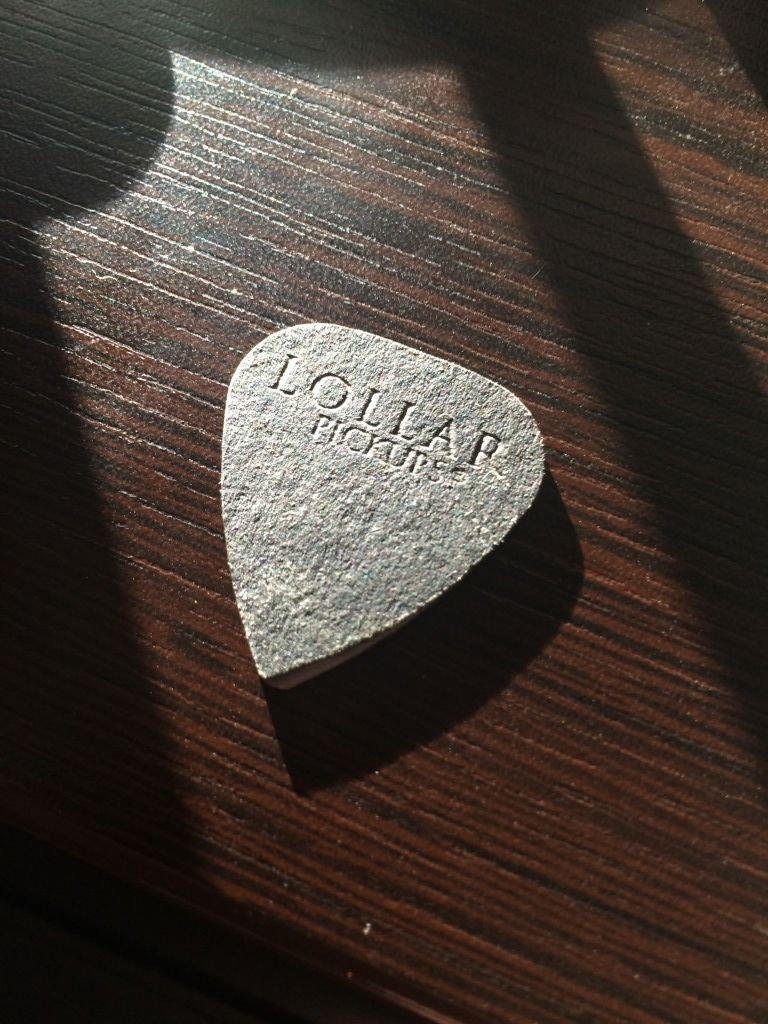 |
| Lollar Pick |
I hope this article will be useful for you. If you have any comments (good or bad) or suggestions, please let me know. It’s nice to know that there is someone at the other end of the wire.